Dreyfusards
An Officer and a SpyThe Dreyfusards are the advocates associated with challenging Alfred Dreyfus’s conviction and the secrecy that protected it. The book presents them not as a single, formally described organization, but as a varied company of writers, editors, lawyers, politicians, and socialists. Their shared significance emerges across different arenas: a closed military hearing, public argument, parliamentary politics, and the struggle over whether a pardon could substitute for clearing Dreyfus’s name.
Identity and Composition
The book introduces the Dreyfusards through a roster rather than an account of formal membership or internal structure. It names Émile Zola; Georges Clemenceau, identified as both politician and newspaper editor; Albert Clemenceau, a lawyer; Auguste Scheurer-Kestner, Vice President of the Senate (France); Jean Jaurès, leader of the French socialists; and the politician and writer Joseph Reinach, alongside the politician Arthur Ranc. The range of occupations matters: the cause appears across literary, journalistic, legal, parliamentary, and socialist settings, rather than belonging to one profession or institution.
That roster does not establish that every named figure took the same actions, held identical views, or belonged to a tightly coordinated body. The evidence gives no constitution, leadership structure, or membership procedure. It instead offers a collective name for people associated with advocacy for Dreyfus. Specific interventions must therefore be distinguished from the broader identity: the book identifies Jaurès with drafting a statement for Dreyfus, while other entries in the roster establish the presence of prominent figures from public life without detailing their individual conduct in the scenes at hand.
The Case They Challenged
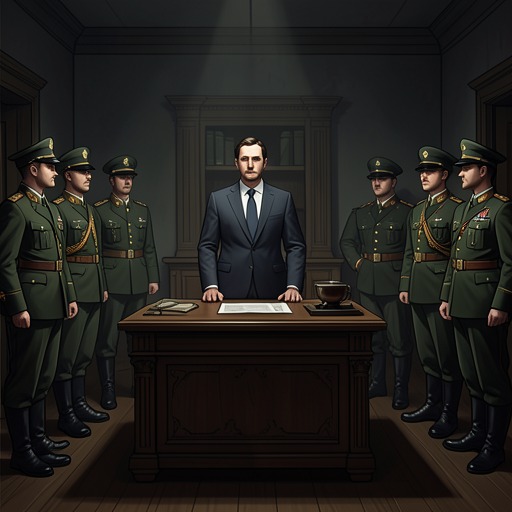
The conditions that made advocacy necessary are visible in the contrast between Dreyfus’s position and the authority of military accusation. At his trial, prosecutor Brisset requested that the hearing be held in private because the case involved national defence. Dreyfus’s lawyer, Edgar Demange, objected that his client had the right to be treated like any other accused person. The prosecution’s appeal to sensitive evidence thus collided with a basic demand for an open and equal procedure: the secret nature of the case was presented as a reason to restrict public scrutiny.
The imbalance was not only procedural. During Dreyfus’s public degradation, a Foreign Ministry official questioned how an innocent man could submit to humiliation without resisting and suggested that such behaviour might be Jewish. Jean Sandherr answered with an explicitly antisemitic claim that Jews lacked patriotism, honour, and pride. The episode shows how prejudice could shape interpretations of conduct: Dreyfus’s composure became, in the observers’ reasoning, evidence against him, while his repeated declarations of innocence were met by abuse from the crowd. The Dreyfusards’ cause concerned a conviction, but the surrounding scenes also expose the hostility that made an accusation against a Jewish officer readily credible to some of its defenders.
The narrator’s recollection of Dreyfus as a former student reveals another form of bias. He remembers having viewed Dreyfus’s wealth, family background, and Jewish identity through suspicion, and recalls Dreyfus directly asking whether a low mark was due to his being Jewish. That earlier encounter does not establish the beliefs or actions of the Dreyfusards. It does, however, show how prejudice could enter ordinary professional judgment before the public controversy, making the later demand to reassess evidence inseparable from the question of who was presumed trustworthy.
Public and Political Arenas
The roster’s mixture of public roles points to the breadth of the dispute. Zola and the two Clemenceaus connect the cause with literature, journalism, politics, and law; Scheurer-Kestner’s position in the Senate (France) places a named advocate within a parliamentary institution; and Jaurès brings the presence of socialist leadership. The book does not reduce advocacy to a single legal tactic. The case moves between courtroom procedure, public statements, political authority, and debate over the evidence itself.
One decisive confrontation concerns the bordereau, the document central to the accusation. When Georges Picquart presented the petit bleu, surveillance photographs, and secret file to Charles-Arthur Gonse, he concluded that the file did not establish Dreyfus’s guilt and would not withstand competent cross-examination. Gonse nevertheless told him to forget the bordereau, even while allowing him to investigate Esterhazy so long as the investigation was not connected to it. The instruction marks the institutional boundary that any challenge to the conviction had to confront: inquiry might be permitted in a limited form, but the evidence tying the case back to its foundation was to remain outside it.
Picquart later challenged the scope of an inquiry directly, asking whether he would be questioned about the evidence that Esterhazy had plainly written the bordereau, including the government expert’s handwriting comparison, or about falsified material in the dossier used to convict Dreyfus. He was told those matters fell outside the inquiry. These scenes do not make Picquart a formally identified member of the Dreyfusards; they show the evidentiary obstacles against which Dreyfus advocacy operated. A case could be discussed while its most consequential questions were excluded from the discussion.
Advocacy, Pardon, and Honour
The movement’s political and legal stakes sharpen when Picquart, with Labori’s help, drafts an open letter to the government. At Labori’s suggestion, the letter is addressed to Prime Minister Henri Brisson rather than to the Minister of War. It argues that the two secret documents dated 1894 cannot be applied to Dreyfus and that the document dated 1896 bears evidence of forgery. It further contends that the Minister of War and those who accepted the documents’ relevance or authenticity had been misled. The letter turns a dispute over concealed military evidence into a claim that could be put before a competent tribunal and addressed to the head of government.
Jaurès’s role becomes concrete at the moment when Dreyfus is to receive his freedom through a pardon. Picquart objects that accepting it amounts to an admission of guilt. Jaurès has prepared a statement for Dreyfus to issue upon leaving prison: it distinguishes release from restored honour and commits him to continuing the effort to overturn the judicial error of which he says he remains the victim. The distinction captures the limits of a pardon. It can end imprisonment, but it does not itself erase the conviction or answer the question of innocence.
The Dreyfusards therefore signify more than a list of distinguished names. In the book’s account, their cause takes shape wherever the official handling of the case is challenged: in objections to a closed hearing, in scrutiny of the secret dossier and the handwriting evidence, in an open letter to the government, and in the insistence that freedom without honour is incomplete. Their varied public positions offer routes into debate, while the scenes of restricted inquiry and antisemitic presumption explain why advocacy had to contest not only a verdict but also the terms on which evidence and credibility were judged.